This is why AWS’s BankIQ Reference Architecture Matters - Even If You’re Not a Bank,
AWS’s BankIQ+ isn’t a product you can buy. It’s a reference solution (sample architecture + code) that shows how regulated firms can use generative AI to turn fragmented public and internal data into evidence-backed, auditable intelligence. The banking use case is the wrapper. The underlying pattern—RAG-grounded answers, agent workflows, and governance-by-design—is highly relevant for insurtechs and broader financial services. (AWS, 13 Jan 2026)
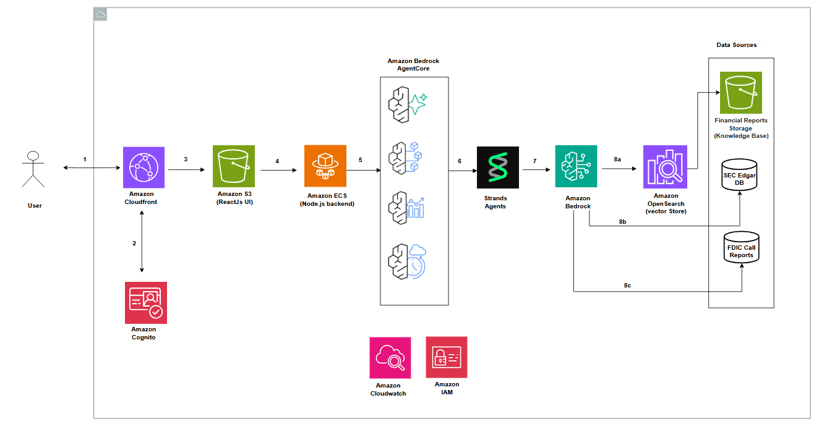
BankIQ+ Application Architecture
In this post, we’ll use BankIQ+ as a concrete reference point (without overhyping it) to extract the practical lessons: how to design GenAI-powered intelligence systems that can stand up to real scrutiny—security review, compliance sign-off, and operational reality.
In this blog, we will cover:
- What BankIQ+ is (and isn’t)
- The architecture pattern that transfers to insurtech
- High-value use cases for insurance and FSI
- Guardrails, auditability, and risk management
- A pragmatic implementation path
1) What BankIQ+ is (and isn’t)
The AWS post describes BankIQ+ as an open-source solution that modernises peer benchmarking and regulatory intelligence using an agent-powered architecture on AWS. It combines Amazon Bedrock, agents, and RAG-based knowledge search with secure AWS data services. (AWS, 13 Jan 2026)
What it is
-
A reference architecture + real code that demonstrates a regulated GenAI pattern. (AWS)
-
An example of how to combine public datasets, RAG, and agents with audit-friendly controls. (AWS)
-
A starting point you can study and adapt (source repo linked in the post). (AWS Samples on GitHub)
What it isn’t
-
A commercial product or managed service.
-
A turnkey deployment you should run “as-is” without tailoring, testing, and controls.
-
A substitute for an operating model (security, compliance, monitoring, ownership).
The practical takeaway: BankIQ+ is valuable because it shows an AWS-endorsed approach to building GenAI intelligence in a regulated context—where answers must be grounded, traceable, and permissioned.
2) The architecture pattern that transfers to insurtech
BankIQ+ is framed around US banking datasets (FDIC, SEC/EDGAR, FFIEC, Federal Reserve, OCC), but the transferable lesson is the pattern: curate data → retrieve evidence → generate grounded answers → orchestrate multi-step analysis → log and control everything. (AWS, 13 Jan 2026)
RAG: grounded answers, not “model guesses”
Retrieval-augmented generation (RAG) is a technique that draws information from a data store to augment LLM responses—so outputs can be linked back to sources. Amazon Bedrock Knowledge Bases explicitly supports this workflow. (AWS Docs: Knowledge Bases “How it works”)
Agents: turn questions into workflows
In the AWS architecture, agents can break down a query, retrieve the right documents, run calculations, compare time periods/peers, and produce summaries. That’s fundamentally different from a “chatbot” bolted onto a PDF store. (AWS)
Governance: auditability and least privilege are part of the design
BankIQ+ highlights identity, monitoring, and least-privilege access patterns (for example, tightly scoped IAM roles and centralised logging/metrics). This aligns with AWS prescriptive guidance that treats grounding/RAG as a core pattern for factual accuracy and contextual relevance. (AWS Prescriptive Guidance)
3) High-value use cases for insurance and FSI
If you’re an insurtech or FSI firm, the BankIQ+ blueprint maps cleanly to intelligence-heavy workflows where (a) data is fragmented, (b) decisions are high-stakes, and (c) you need evidence trails.
Use case cluster 1: product, pricing, and competitive intelligence
-
Compare competitor disclosures, product terms, and positioning over time—returning cited evidence, not just summaries.
-
Track market narratives and “what changed” across documents (with retrieval links to the source sections).
Use case cluster 2: regulatory and audit support
-
Draft regulatory narratives with citations, plus checklists of supporting artefacts.
-
Detect inconsistencies across submissions and highlight where supporting evidence is missing.
Use case cluster 3: risk and claims intelligence
-
Summarise cohort movements and drivers (loss ratio drift, severity spikes) with evidence and reproducible queries.
-
Enable faster investigation briefs that link back to internal reports, notes, and governed datasets.
4) Guardrails, auditability, and risk management
In regulated environments, “useful” isn’t enough. You need “defensible”. That typically means: cited sources, controlled access, reproducible outputs, and a clear operating model for review and escalation.
Regulators and standard-setters are explicit about safe adoption
The Bank of England and FCA established the AI Public-Private Forum to encourage safe adoption of AI in financial services, covering governance and risk considerations. (BoE/FCA AIPPF Final Report (PDF); FCA AI Update (PDF))
For broader AI risk management practices, the NIST AI Risk Management Framework is widely used as a reference for trustworthy AI across the lifecycle. (NIST AI RMF 1.0 (PDF))
What “defensible GenAI intelligence” looks like in practice
-
Evidence-first answers: RAG with source citations and “I don’t know” behaviour when evidence is missing. (AWS Bedrock Knowledge Bases)
-
Audit trails: log prompts, retrieved passages, model versions, and outputs—so decisions can be reviewed later. (AWS)
-
Human-in-the-loop controls: explicit review gates for high-impact outputs (regulatory responses, pricing recommendations, customer-facing text).
5) A pragmatic implementation path
One of the most useful signals in the BankIQ+ post is that this isn’t framed as “big bang transformation”. It’s positioned as a phased approach: start with a small set of sources and questions, then expand coverage and automation. (AWS)
Days 1–30: choose one decision and make it evidence-grounded
-
Pick one workflow (e.g., competitor term changes, regulatory narrative drafting, claims trend briefs).
-
Curate the minimum viable corpus and implement RAG with citations. (AWS: how knowledge bases work)
-
Define acceptance tests: accuracy vs baseline, citation coverage, refusal correctness.
Days 31–60: introduce agent workflows for repeatable analysis
-
Turn “questions” into “workflows”: retrieve → compare → calculate → summarise → escalate.
-
Add monitoring and governance controls as you expand access. (AWS Prescriptive Guidance)
Days 61–90: harden for production and prove impact
-
Operationalise logging, access control, incident response, and cost guardrails.
-
Track business outcomes: cycle time reduction, analyst hours saved, decision turnaround, audit readiness.
-
Scale only what proves repeatable value—McKinsey’s banking work highlights that material value comes from rewiring workflows, not isolated pilots. (McKinsey (Dec 2024))
The bottom line
BankIQ+ matters because it shows what “good” looks like when GenAI meets regulation: evidence-grounded answers, agent-driven workflows, and governance built in from day one. You don’t need to be a bank to benefit from that blueprint.
The real challenge for most insurtechs building something that is compliant and holds up at a production level, and this architecture shows you how.
If you’re stuck between demo and production
We help teams sanity-check readiness, scope the right first use cases, and design pilots that are small enough to move fast, but robust enough to pass a compliance review.
Want a 60-day pilot plan for claims, pricing, or regulatory intelligence?
Email hello@CloudCombinator.ai for a readiness + scope check.
Insurtech starter pack: 3 contained pilots
For teams looking to start pragmatically, we often recommend one of these tightly scoped, decision-led pilots — each designed to prove value and defensibility.
-
Claims triage brief with citations
AI-generated investigation summaries that surface drivers, anomalies, and next steps — with links back to the underlying claims data and documents. -
Policy wording change tracker
“What changed?” analysis across versions of policy documents, endorsements, or competitor terms — highlighting material differences with evidence. -
Regulatory change digest + checklist
A monitored feed of regulatory updates that produces summaries, impact notes, and an auditable checklist of required follow-ups.
Each of these can be delivered as a contained pilot using the same GenAI patterns described in this post: curated data, RAG grounding, agent workflows, and governance by design.
If you’d like to explore which pilot fits your data, risk posture, and priorities, get in touch at hello@CloudCombinator.ai .